Blackstone2026-11-03 04:26:58Blackstone President Jon Gray Says Rising AI Costs Will Drive Larger FundraisingBlackstone President Jon Gray said rising artificial intelligence costs are intensifying competition for capital and will force larger-scale fundraising, according to a Techub News brief citing Crypto Briefing. Gray also said the shift could affect how major technology companies shape their strategies. In his view, the change may reshape the broader investment landscape as AI-related spending continues to climb. The report did not provide further details on timing, deal size, or specific companies.1040
Apple2026-11-03 03:01:16Apple faces a real valuation test after reclaiming the top market cap spotApple has returned to the top of the global market-cap rankings and briefly crossed the $5 trillion mark, helped by a restrained spending profile and a surge in free cash flow while other Big Tech companies keep pouring money into AI infrastructure. But the company’s latest earnings release, the first under new CEO John Ternus, showed why that premium is now under pressure. For the quarter ended Sept. 26, 2026, Apple reported revenue of $114.477 billion, up 11.72% year over year, and net income of $30.711 billion, both ahead of Wall Street expectations. Full-year revenue reached a record $478.834 billion, while free cash flow climbed to $136.056 billion. That cash generation supported $86.390 billion in share repurchases and $15.721 billion in dividends. Still, the stock fell in after-hours trading after management warned that rising memory chip costs and Siri AI rollout expenses would drag gross margin in the December quarter to 45% to 46%. Services, a key profit engine, also showed slower growth, with quarterly revenue rising 9.82% to $31.573 billion and next-quarter growth projected at 8% to 9%. The report left investors weighing Apple’s cash-flow strength against margin pressure, softer services momentum, and the demands of a $5 trillion valuation.700
Market Analys2026-10-31 11:55:24Bloomberg editor says AI spending payoff fears are weighing on big techTechub News, citing Bloomberg, said Bloomberg senior editor Mike Shepard pointed to growing investor concern over whether heavy artificial intelligence spending will generate sufficient returns. He said disappointing earnings from major technology companies have added to that pressure, with Alphabet and Intel facing especially close scrutiny. Shepard also discussed the $6.3 billion Binance hack and said North Korean hackers could be behind the attack. The remarks tied pressure on large-cap tech shares to doubts about the payoff from large AI budgets, while also touching on one of the biggest security incidents referenced in the report. No additional details on the earnings results or the hack investigation were provided in the source item.540
Jim Cramer2026-10-30 02:03:49Jim Cramer says buy Microsoft, hold off on AlphabetJim Cramer said investors should buy Microsoft following the latest round of Big Tech earnings, while taking a more cautious stance on Alphabet. His view on Microsoft centered on cash generation and management style. He said the company continues to post positive free cash flow and described its leadership as running the business like an enterprise rather than a science project. Cramer drew a different conclusion on Alphabet. He said the company has posted negative free cash flow for two straight quarters and called the burden too heavy at this stage. Instead of recommending an immediate entry, he said investors may want to wait until analysts cut their expectations before considering a purchase. The update was cited by Techub News and attributed to BeInCrypto. The source material did not provide additional financial figures or a more detailed timeline beyond the reference to the latest earnings reports from major technology companies.480
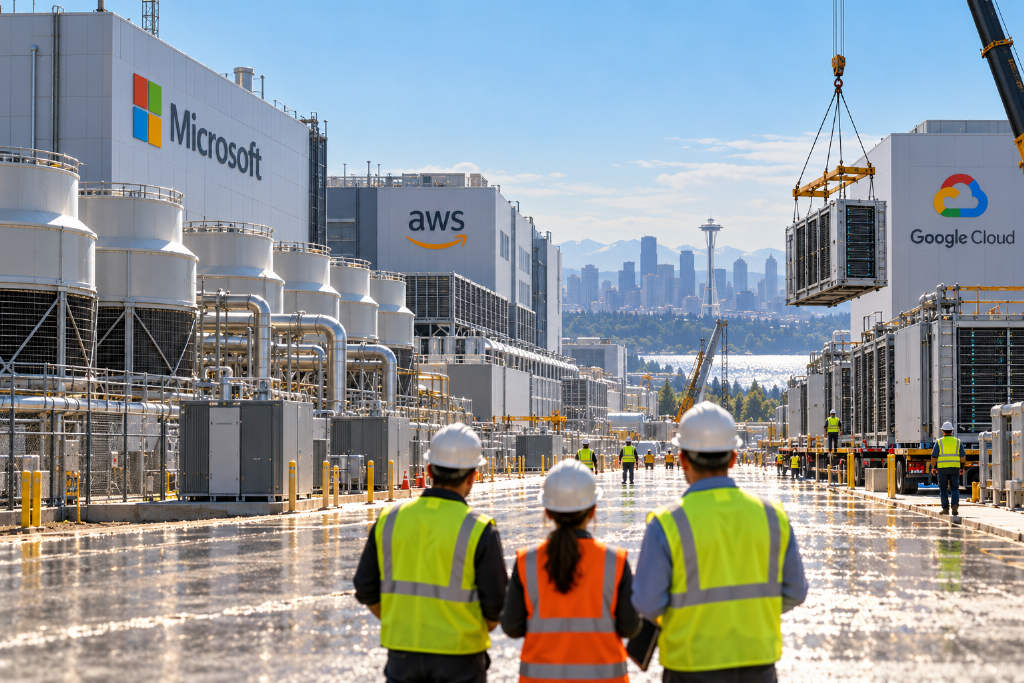
AI financing2026-10-29 05:18:42Wall Street’s AI financing pipeline shows strain as 18 data center deals move into double-digit yieldsBloomberg reported that Wall Street is showing early signs of hitting its capacity limits in financing AI data centers, chips, and related infrastructure. At least 18 data center-linked high-yield bonds or leveraged loans are now offering double-digit yields, while banks are finding it harder to move risk off their books to insurers and other investors. Interviews with more than 30 bankers, asset managers, private equity executives, and industry participants pointed to a clear shift from just a few months ago, with fundraising becoming materially tougher. The pressure is showing up in borrowing costs. Morgan Stanley ABS strategist Carolyn Campbell said top-rated data center bonds yielded less than 5% in early 2026, versus nearly 7% for similar paper now. Bloomberg also highlighted a $5 billion syndicated loan arranged by JPMorgan and Goldman Sachs for Neocloud operator Volta Infrastructure Holdings that ended up yielding more than 11% after deeper discounts and higher interest were required. Citadel Securities said the bigger issue is not only whether projects can be financed, but who is willing to hold the debt. Bloomberg added that stress has spread beyond leveraged Neocloud operators into the credit market for major tech names, with CDS costs for Oracle, SpaceX, NVIDIA, and Meta all reaching record levels.640
Raoul Pal2026-10-29 01:27:46Raoul Pal says AI capex has no clear ceiling as Big Tech debt stays near 3.5% of market valueRaoul Pal said hyperscale cloud companies are channeling some of the world’s strongest cash flows into what he described as the largest capital spending cycle on record, creating a self-reinforcing loop. In his view, large technology companies are still carrying very limited leverage, with debt at roughly 3.5% of market capitalization. He pointed to recent company figures to show how uneven the spending wave has become. Alphabet reported negative quarterly free cash flow of $9.07 billion as AI investment weighed on results, and its shares fell. Microsoft, by contrast, posted $18.6 billion in free cash flow and its stock rose. Pal also cited forward spending plans, saying Amazon is expected to spend about $220 billion in capital expenditures in 2026, while Alphabet’s budget could reach as much as $205 billion, including infrastructure beyond AI. He added that private bank Union Bancaire Privée estimates the five largest hyperscale cloud providers will spend $820 billion in 2026, above projected operating cash flow of $750 billion. The Bank of England has also warned that AI infrastructure is becoming increasingly dependent on borrowing and complex financing structures.660
AI2026-10-27 05:11:13AI Trade Faces a Funding Test as Big Tech’s Spending Race Turns ReflexiveTwo warning signals hit the AI infrastructure trade last week: CoreWeave was pressured in both equity and debt markets, pushing up its funding costs, while Meta’s heavy AI capital spending and negative free cash flow revived questions about returns on investment. Together, they point to a broader issue. As AI buildouts rely more on external funding, the durability of the spending race is coming under closer scrutiny. Reuters, citing analysis of LSEG consensus data, said Microsoft, Alphabet, Amazon, Meta and Oracle are on track for total capital expenditures to exceed free cash flow by 2027. For every additional $1 of operating cash flow, the group is expected to add about $1.57 of capex. That gap suggests a shift away from the asset-light model that once defined large technology platforms. Research from Cornell Capital Group and commentary from investors including Citrini and analyst Amin Mrini frame the current setup through two ideas: a prisoner’s dilemma that keeps every major player spending, and reflexivity, where confidence supports financing, financing supports investment, and investment supports growth expectations. If sentiment weakens, that loop can reverse. The market is also beginning to separate companies that can turn AI spending into pricing power and revenue growth from those still selling standardized compute.1000
Mistral2026-10-25 14:18:24Mistral looks to open-source models to take on Big TechFrench AI company Mistral is trying to challenge large technology companies with an open-source model strategy, according to Techub, citing Bloomberg. The company argues that open models can give customers lower costs, stronger control over their data, and greater technological autonomy. Those points form the core of Mistral’s pitch as it seeks a different route into the AI race. The effort comes as Europe remains behind the United States in the competition to build large AI models. The report says Europe has been held back by a smaller capital market and a fragmented business environment. Even so, Mistral is still aiming to compete by taking a differentiated path rather than following the same approach as larger US rivals.770